Election Year 2026: Can We Still Trust What We See?
| Time to read:6 minutes
The year 2026 is and will continue to be an intense election year, with nearly half the world’s population heading to the polls. As highlighted by the UNDP, this massive wave of democracy makes the impact of AI and social media more critical than ever.
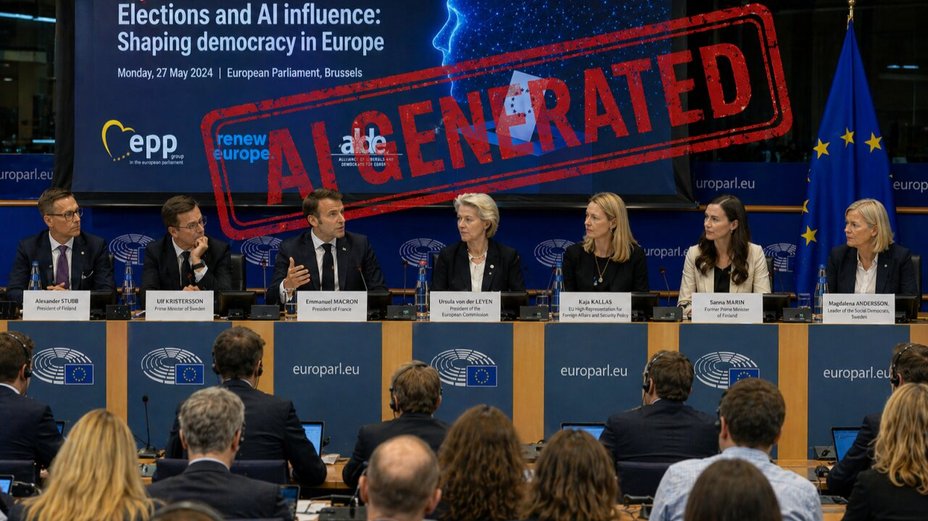
Across Europe, political attention is increasingly turning toward upcoming national elections and shifting coalition dynamics. In the Nordic region, Sweden is preparing for its September 2026 general election. While Slovenia, Denmark and Portugal have already held their elections, other countries such as Czech Republic, Latvia, and Estonia continue to navigate evolving political landscapes, coalition negotiations, and preparations for future electoral cycles.
This synchronization means that digital platforms are central to civic life across every timezone simultaneously. At SomeBuddy, we are seeing how this creates a new frontline for digital safety. A recent survey in Sweden shows that 9 out of 10 people believe AI will be used to impact upcoming elections. Given how photorealistic AI-generated content has become, this isn't just a prediction, it is a reality we are already witnessing in our feeds.
Note for those in Sweden: You can catch my recent segment on TV4 Nyhetsmorgon (April 2026), where Carl Heath and I discussed these exact risks and how they are currently playing out in the Swedish context.
The Platform Arms Race and the Creative Frontline
We are currently witnessing a literal arms race among digital platforms to develop the most seamless AI features. Social media giants are no longer just hosts; they have become the primary tools for the "creative process." For example, X’s much-discussed Grok has already drawn a formal investigation from the European Commission under the DSA to assess its role in spreading disinformation. Simultaneously, TikTok’s AI Alive and Symphony suites allow users to create lifelike "digital avatars," while Meta AI enables anyone to generate images and "bring creations to life" through synthetic video.
This accessibility means the barrier to producing high-impact political content has effectively vanished. A recent study by Sitra (Algorithms and Democracy, 2026) highlights this new reality, noting that AI tools are often paired with powerful algorithms that favor polarizing content. This creates a 'polarization gap' where different demographics are funneled into entirely different, AI-driven echo chambers. We are already seeing concrete examples of this—from manipulated videos in Finland making politicians appear to give Nazi salutes and cloned voices creating deepfake speeches, to AI-generated humans, animals, or memes used to push specific political agendas.
The Regulatory Framework: AI Act vs. DSA
To understand how AI is governed in 2026, we must distinguish between the rules for the technology itself and the rules for the platforms where it is shared.
The EU AI Act: The AI Act serves as the "master regulation" for AI systems. However, it is important to clarify a significant legal detail: while the framework is set, the specific requirement to label AI-generated content (Article 50) is not yet in force as a binding requirement. It is currently in a transition phase and will only become mandatory on August 2, 2026. Until then, the burden of labeling remains largely on voluntary commitments or other broader safety regulations.
The Digital Services Act (DSA): In the meantime, the DSA dictates how online platforms like Meta and TikTok must manage content to protect electoral integrity. The DSA requires platforms to analyze systemic risks and implement mitigation measures. While we wait for the AI Act's labeling mandate to become fully binding, the DSA provides the grounds for the Commission to investigate platforms if their AI tools are being used to deceive voters without sufficient safeguards.
Digital First Aid: How to Approach AI Content Critically
AI tools are evolving at a breakneck pace, making it increasingly difficult to distinguish generated images and videos from the real thing. While we often think we can spot a fake, visual cues are no longer enough. We must learn to look at the context.
Ask yourself these four questions when you see something suspicious:
- Who published the content and what is their history? Check if the account is a known, reliable news outlet, a random meme account, or an anonymous creator.
- What do other sources say? If it’s major news—like a high-profile arrest—it should be reported by credible media. Use tools for a reverse image search to see when and where the image was originally used.
- What is the goal of the content? Is the publisher looking for clicks and money? Are they trying to sell a product that seems too good to be true? Or are they trying to influence your opinion about a certain group or political issue?
- Does the content trigger strong emotions? AI content is often designed to spark anger, fear, or intense excitement. When we have a strong emotional reaction, our brain’s critical thinking takes a backseat, making us more likely to believe falsehoods.
Quick Check-List for Social Media
- Verify the Account: When was it created? What else do they post?
- Seek Confirmation: Can you find this information from multiple reliable sources?
- Think About Motive: Who benefits if you believe this? Is it an ad disguised as news?
- Recognize Your Emotions: If it makes you feel extreme emotion, be extra cautious. You are at your most vulnerable to misinformation when you are angry or excited.
Pause before you share. Awareness is the first step, but transforming that awareness into a habit of digital skepticism is what ensures our democracy remains a space for genuine human debate.
While we as individuals can take steps to be more critical, it is also essential that platforms ensure they are not being misused. We can do our part by staying informed, but the responsibility for safety cannot rest solely on the voter. Platforms must be held accountable for the integrity of the information environments they host.
References & Resources:
- UNDP: 2026: The Super Year for Elections
- Svenskarna och internet 2026, valspecial: Link
- Sitra (2026): Algorithms and Democracy (Publication 256)
- European Commission: Latest update on the AI Act timelines.
- TV4 Nyhetsmorgon: Segment on AI and election interference from 03:11 (April 22 2026). Link
We hope you enjoyed this newsletter. For more information about SomeBuddy and our mission to help keep our users safe in online spaces you can visit our website.
Also - if you have any questions, thoughts or perhaps suggestions for our next newsletter, please reach out to me at essi@somebuddy.com
Stay safe online!
Essi Alho, Head of Nordics, SomeBuddy
Kaisa Rissanen, Head of Legal and Operations, SomeBuddy